May 12, 2012

The Divine Comedy

A Medieval Journey Through Hell, Purgatory and Heaven

Loved the poetry.
Could have done with less
medieval astronomy.

This was my first reading of The Divine Comedy. I was blown away by some fragments of poetry. The amalgamation of classical and biblical references with modern (for Dante) political and religious intrigue was interesting. On the other hand, I kept losing the flow of the poem because I didn't recognize Dante's contemporary references--I had to either stop and check the notes or continue without understanding

The Divine Comedy takes a lot of its structure from Ptolemaic astronomy which I have very little familiarity with, so again, I depended heavily on the notes. It's kind of hard to know the constellations when you live in Tokyo and can usually see only a few stars at night.

After being totally engrossed by The Iliad, The Odyssey, and The Aeneid, I found The Divine Comedy tough going. If it weren't for some insightful bits of beautiful poetry (like the one below on the inability for humans to fathom God's justice), I might have put the book down. A second reading will surely help, but I'm not interested enough in teh book to tackle it again right away.

"therefore, the vision that your world receives
can penetrate into Eternal Justice
no more than eye can penetrate the sea;
for though, near shore, sight reaches the sea floor,
you cannot reach it in the open sea;
yet it is there, but hidden by the deep."
Divine Comedy, Paradiso XIX, 58-63

The Divine Comedy - Dante Alighieri

May 4, 2012

Why Christians Should Read Literature

Many Christians wonder whether reading fiction is a good use of time. In an interview with Tim Challies, Russell Moore, the Dean of the School of Theology and Senior Vice-President for Academic Administration at The Southern Baptist Theological Seminary, discusses the benefits, possible dangers, morality, and responsibility of reading fictional literature.

Here are some of the benefits Moore sees of reading literature:
  • "Fiction helps to shape and hone . . . the moral imagination."
  • "Fiction can sometimes, like Nathan the prophet’s story of the ewe lamb, awaken parts of us that we have calloused over, due to ignorance or laziness or inattention or sin."
  • "Fiction helps the Christian to learn to speak in ways that can navigate between the boring abstract and the irrelevant mundane."
  • Fiction teaches empathy
  • Fiction is "rooted in an endlessly creative God who has chosen to be imaged by human beings who create."
Moore also shares his personal guidelines for whether or not to read a book that might contain objectionable material, and muses on the difference between literature and mere fiction.

Challies asks Moore to recommend a few contemporary novels. Moore's first and highest recommendation is for A Confederacy of Dunces. On his recommendation, and in spite of the hideous cover art, I downloaded it for my kindle. Happy reading!

Read the whole interview here.

A Confederacy of Dunces - John Kennedy Toole

May 3, 2012

Read Camus with a Wheaton Professor

Professor Leland Ryken, a professor of English at Wheaton College is leading a discussion of Albert Camus's The Stranger. It's a great opportunity to read and discuss a classic under the guidance of an eminent Christian man of letters. He s going through a chapter a week, with his comments on chapter 2 just being posted today. I found a copy at my local library and caught up with the reading and discussion today. I'm commenting there as Jeremy. Here are links to what's going on so far.
See you there!

Albert Camus - The Stranger

    April 25, 2012

    Reason for Difficulties

    "Everything difficult indicates something more than our theory of life yet embraces, checks some tendency to abandon the straight path, leaving open only the way ahead. But there is a reality of being in which all things are easy and plain--oneness, that is, with the Lord of Life; to pray for this is the first thing; and to the point of this prayer every difficulty hedges and directs us." -George MacDonald

    Edited by C. S. Lewis, this book contains 365 short excerpts from George MacDonald's writings. The above quote is one I've been rereading and pondering for a couple weeks.

    George MacDonald's work is in the public domain. You can learn all about him and get links to his writings on the George MacDonald Informational Web.

    George MacDonald - Anthology

    April 22, 2012

    A Praying Life

    Let go of guilt about prayer and live connected to God as he intended.

    Prayer is part of life,
    Not just for some holy few.
    Talk to the Father.

    Paul Miller, in A Praying Life, addresses all the normal obstacles to prayer--from short attention spans to honest doubt about what good prayer does--and encourages us not to give up. He reminds us of the relationship we have with God and urges us to make that relationship a natural part of our everyday lives. Miller's theology is rich and practical. He refers often to struggles that he and his wife face with their adult daughter who is autistic. I've read several books about prayer, and this is the one that has benefited me most so far. Just writing this makes me want to go back and read it again!

    A Praying Life - Paul Miller

    April 21, 2012

    New Testament History

    Revitalize your reading of the New Testament

    Knowing the background
    Brings God's holy word to life,
    So read history.

    Besides the epic poems, I'm reading books that help me with my life of faith. F. F. Bruce's New Testament History has been on my shelf for a long time. I'd used it for reference before, but read it cover-to-cover for the first time this January. It helped me understand, among many other things, the complicated status of Judea; who the Pharisees, Sadducees, and Essenes were; and why Paul's preaching to God-fearing gentiles in the synagogues was so successful and controversial. My daily devotions have been enhanced by what I learned in this book.

    New Testament History by F. F. Bruce

    The Iliad of Homer

    Where Western literature began

    Unquenchable rage,
    Even when it's justified,
    Leads only to hurt. 

    So begins my mission to read good books well. This was my third reading of the Iliad, but my first time as a father. Two scenes that touched me in new ways are when Hector returns to Troy and meets his wife and baby son, and when Priam goes to the Greek camp to beg Achilles for his son's body.

    Iliad of Homer, translated by Robert Fagles

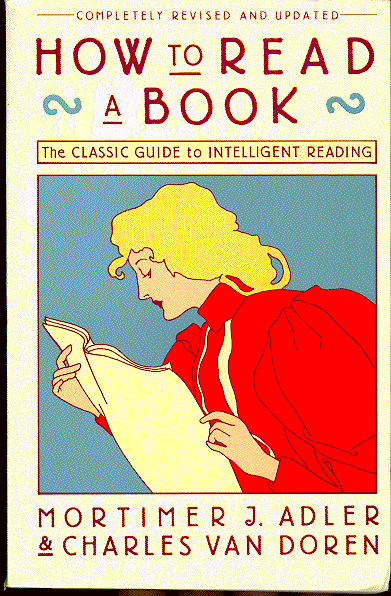
    How to Read a Book

    The book that inspired the mission

    Pretentious title?
    Maybe. But it does the job
    It sets out to do.

    How to Read a Book by Mortimer Adler

    Mission: Read Good Books Well

    This is the year I regain my attention span through reading.

    photo credit
    I've always been a reader--I even earned a degree in literature two decades ago. Over the past several years, I noticed a change in my reading habits. I began reading more blogs, news, and light "tricks and tips" related to my profession, and less fiction, poetry, and challenging nonfiction. As my reading habits changed, I observed troubling changes in my thinking patterns and attention span too. Deep analysis and divergent thinking became tedious. I found myself thinking in terms of quick fixes and bullet lists,
    • which
    • isn't
    • necessarily
    • good.
    The catalyst for change came during winter break last year. We planned a family trip to visit the in-laws. Knowing that I'd have plenty of time to read (and that the internet connection would be flaky), I threw Mortimer Adler's How to Read a Book into my backpack. I devoured that book in a week. The message was simple and challenging:

    Read good books well.

    That's my mantra this year. I determined to read challenging books and to read them rigorously.

    But what to read? I set a goal to read five epic poems: The Iliad, The Odyssey, The Aeneid, The Divine Comedy, and Paradise Lost. (Links are to the translations I'm reading, except for Paradise Lost which was written in a language I happen to know.) To keep from burning out on the genre, I decided to take a month or two for each book and intersperse some other edifying books among them for variety.

    This blog is the book-by-book record of my reading. I'll post what I'm reading, some general impressions, and a very brief review (maybe a haiku). I welcome your reading suggestions, questions, and encouragement. Feel free to leave comments, subscribe, and share on your social networks. Just don't let it take you away from your reading!